research & PRojects

Urban movement modeling

Pedestrian volume models and movement simulation are used for mobility, transportation planning, and evaluating crash risk

Urban morphology             

Spatial configuration and land use patterns of Israeli cities and their implications on the formation of social and functional urban areas 

Spatial cognition & behavior

The association between cognitive mapping, the environment's characteristics and movement

walking and walkability

The association between cognitive mapping, the environment's characteristics and movement

___2_.jpg


urban movement modeling

3a-1.jpg

PEDESTRIAN VOLUME MODELING

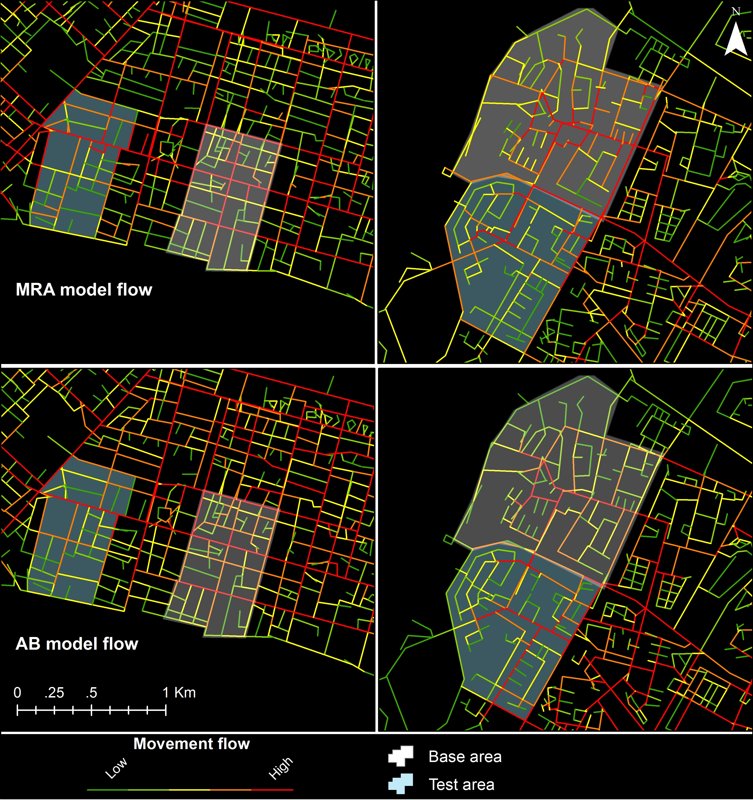
We construct pedestrian volume models by using street network' centrality measures and geographic information on the urban environment. The models are used for understanding the relations between movement and urban environments that were established according to different planning approaches and as tools for Mobility and Transportation Planning.

Selected papers:


MOVEMENT SIMULATION

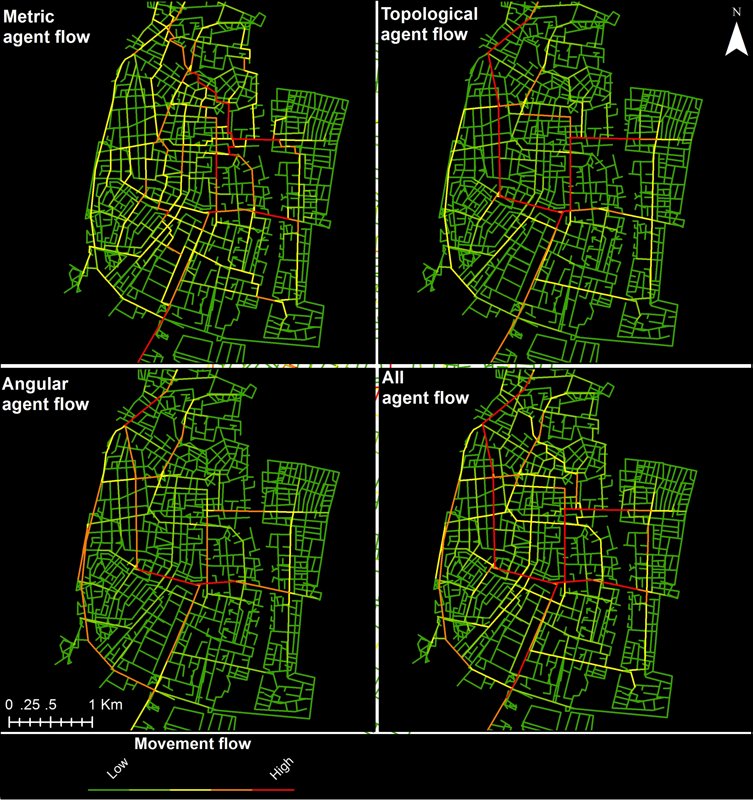
We developed an Agent Based (AB) model  for simulating movement in urban environments. The model was constructed by transforming the various street network centrality measures and land-use variables used in space syntax modeling into agents' spatial behavior parameters. The advantage of our AB model lies in its ability to simulate the combined effect of the street network structure and land-use pattern on movement flows in urban street networks.

Selected papers:

3c.jpg

EVALUATING CRASH RISK

We developed a method for evaluating the spatial distribution of vehicle and pedestrian traffic crashes relative to the volume of vehicle and pedestrian movement in urban areas.

Selected papers:

Urban morphology & CONFIGURATION

2a.jpg

SPATIAL CONFIGURATION AND LAND USE PATTERN

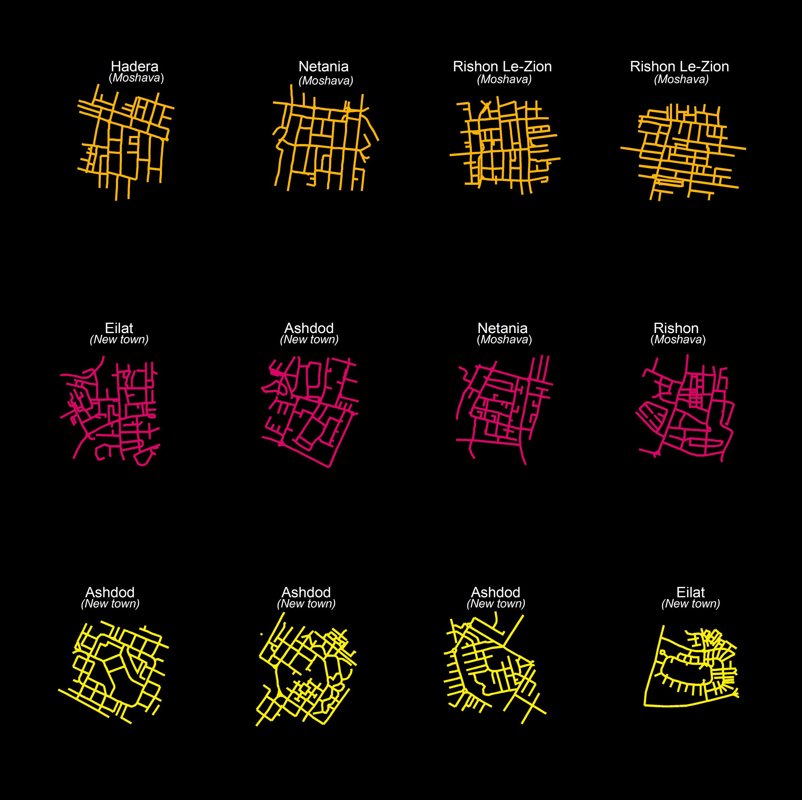
Street patterns, spatial integration and land use patterns of Israeli city types with respect to planning approaches.

Selected papers:

  • Upcoming book - Soon to be published:  The Israeli City: Structure, morphology, sustainability.   Center for Urban and Regional Studies, Technion − Israel Institute of Technology,

2b.jpg

THE FORMATION OF SOCIO- ECONOMIC AREAS

The effect of urban morphology - city's spatial configuration and land use patterns - on the formation of socio-economic areas.

Selected papers:

  • Magen, R. Omer, I. and Rofe, Y. (2024). The impact of global and local integration on the social functioning of neighborhood green public open spaces (GPOS)

SPATIAL BEHAVIOR AND COGNITION

SPATIAL COGNITION

We study how cognitive maps are affected by the conditions of the environments (e.g., regional categories), and specifically how a city’s form and its internal socio-spatial divisions affect cognitive representation of an urban environment.

Selected papers:


SPATIAL behavior

We concentrate on the individuals' spatial cognition during urban movement: how perception and cognitive presentation of distances affect the selection of movement routes in the urban street network.

Selected papers: